
Last Updated: November 17, 2026
Quick Summary
Choosing commercial property insurance starts with confirming what the policy covers: buildings, business personal property, and tenant improvements, then reading exclusions twice. Compare quotes on valuation basis, deductibles, coinsurance, and endorsements, and set limits from a reconstruction-cost estimate rather than a guess.
- Building coverage protects the structure; business personal property covers tools, inventory, furniture, and computers.
- Standard forms typically exclude flood, earth movement, employee dishonesty, wear and tear, and faulty workmanship.
- Replacement cost pays to rebuild with no deduction for age; actual cash value subtracts depreciation.
- A coinsurance clause commonly requires insuring to 80 or 90 percent of value or claims are reduced proportionally.
- Reassess values and limits at each renewal and after renovations, acquisitions, or major equipment purchases.
Table of Contents
- Start With What Your Commercial Property Insurance Coverage Actually Includes
- Commercial Property Insurance Exclusions You Need to Read Twice
- Replacement Cost vs. Actual Cash Value Commercial Property Insurance
- How to Estimate Your Property Value and Coverage Limits Without Guessing
- Underinsurance and the Coinsurance Clause: The Calculation That Trips Up Owners
- What to Compare on Every Commercial Property Insurance Quote
- Location, Endorsements, and Renewal: The Gaps Most Buyers Miss
- Request a Coverage Review From BIG Insurance
- Frequently Asked Questions
Start With What Your Commercial Property Insurance Coverage Actually Includes
Choosing commercial property insurance starts with knowing exactly what the policy protects. You can review the insurer’s commercial property coverage offering and get a quote. Commercial property insurance coverage is a first-party policy that pays to repair or replace the physical assets your business owns or occupies when a covered peril damages them. Many coverage gaps come from vague assumptions rather than from the policy itself.
Three asset groups sit at the center of every policy:
Buildings, Business Personal Property, and Tenant Improvements
Building coverage protects the structure itself: walls, roof, electrical, plumbing, and permanently attached fixtures. Business personal property covers what you move in and out: tools and equipment, inventory, furniture and fixtures, computers, and supplies. Tenant improvements are the upgrades you paid for in a space you lease, and they need their own limit because the landlord’s policy will not pay for them.
Owned Versus Rented Property: Three Different Coverage Needs
An owner-occupier insures the building and the contents. A landlord insures the structure but usually not a tenant’s belongings. A tenant needs contents coverage plus tenant improvements and betterments, and often a small amount of building coverage for alterations they made. Get this classification wrong and you will either overpay or leave a real exposure uninsured.
Commercial Property Insurance Exclusions You Need to Read Twice
The exclusions section is where many claims are denied, and it deserves close attention alongside the declarations page. Standard forms typically exclude flood, earth movement, employee dishonesty, wear and tear, and damage from faulty workmanship. Read the exclusions before you compare premiums, because a cheap quote is often cheap precisely because it removed something you assumed was included.
Flood, Earthquake, and Wind: What Standard Policies Leave Out
Flood and earthquake coverage are usually separate purchases, not add-ons buried in the base form. Wind may carry a separate deductible stated as a percentage of the building limit rather than a flat dollar amount. If your property sits in a storm or seismic zone, ask for those terms in writing. Our team can walk through business insurance protection from earthquakes and floods so you know what a standard policy leaves on the table.
Replacement Cost vs. Actual Cash Value Commercial Property Insurance
The choice between replacement cost vs. actual cash value commercial property insurance is the single biggest factor in how much a claim actually pays. Replacement cost pays to rebuild or replace with new materials of similar kind and quality, with no deduction for age. Actual cash value pays replacement cost minus depreciation, so an older roof or aging equipment returns far less than it costs to replace.
| Basis | What the Claim Pays | Best For | Trade-off |
|---|---|---|---|
| Replacement cost | Full cost to rebuild or replace today | Buildings, critical equipment, inventory | Higher premium |
| Actual cash value | Replacement cost minus depreciation | Older assets you plan to retire | Lower premium, bigger out-of-pocket gap |
| Functional replacement cost | Cost of a modern equivalent | Older buildings with outdated construction | Middle-ground pricing |
Replacement cost is often the default choice for buildings and production equipment, while actual cash value may suit assets you plan to replace with something smaller. If you want the fuller explanation of how the two bases differ in practice, see why replacement cost coverage matters for valuables.
How to Estimate Your Property Value and Coverage Limits Without Guessing
Most underinsurance starts with a limit someone picked because it felt about right. A repeatable valuation method works better than relying on a single number. Estimate building value from reconstruction cost, not market value or your purchase price: what it would cost today to rebuild at current local labor and material rates, to code. Add contents at replacement cost, then add business interruption and extra expense.
Step 1: Value the Building at Reconstruction Cost
Reconstruction cost is not the same as market value, assessed value, or what you paid. Market value includes land and location; assessed value is a tax figure that often lags replacement costs; purchase price reflects a negotiation, not a rebuild. A reconstruction-cost estimate should include:
- Demolition and debris removal
- Site preparation and foundation work
- Labor and materials at current local rates
Owners sometimes anchor on a per-square-foot figure from years ago. Material and labor costs move, so a number that was accurate five years ago can leave a building underinsured today. A professional reconstruction-cost estimate is commonly recommended at purchase, after major renovations, and at each renewal.
Step 2: Inventory Business Personal Property at Replacement Cost
Business personal property is easy to underestimate because it accumulates quietly. Walk each space and list:
- Furniture, fixtures, and leasehold improvements you paid for
- Computers, phones, and office equipment
- Tools, machinery, and production equipment
Value each item at what it would cost to replace today, not what you paid. For inventory, use your highest seasonal or peak level, because a loss in your busiest month is the exposure the limit has to cover.
Step 3: Set Limits That Reflect the Worst Case
A limit should cover the maximum probable loss, not the average claim. For buildings, that means full reconstruction cost plus debris removal and code upgrades. For business personal property, peak inventory plus replacement of all equipment.
Step 4: Reconcile the Limit With the Coinsurance Clause
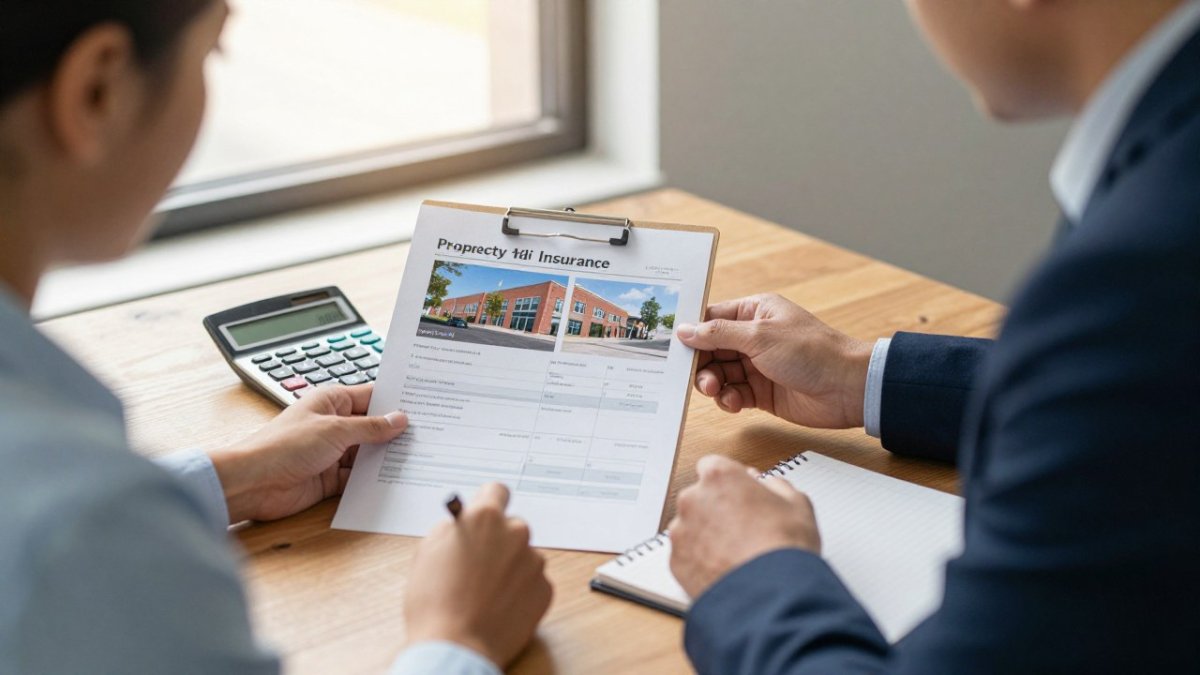
Your limit has to satisfy the policy’s coinsurance percentage, commonly 80 or 90 percent of value.
For a structured method, our guide on how to estimate the value of your business structure walks through the reconstruction-cost approach step by step.
Watch out: A limit that matches your mortgage balance or your last appraisal is not a reconstruction-cost estimate, and it can leave you underinsured.
Underinsurance and the Coinsurance Clause: The Calculation That Trips Up Owners
A coinsurance clause requires you to insure to a stated percentage of value, commonly 80 or 90 percent, or the claim is reduced proportionally. The formula is simple: divide the limit you carried by the limit you should have carried, then multiply by the loss. Carry $600,000 on a building that should be insured for $1,000,000 under an 80 percent clause, and a $100,000 loss pays $75,000.
What to Compare on Every Commercial Property Insurance Quote
Quotes are only comparable when you line up the same terms side by side. Use this worksheet on every proposal:
- Policy limits for building, business personal property, and tenant improvements
- Valuation basis: replacement cost, actual cash value, or functional replacement
- Deductibles, including separate wind and hail deductibles
Our guide on how to compare commercial insurance quotes gives you a fuller framework for that review. A lower premium on narrower coverage is not a better deal.
Location, Endorsements, and Renewal: The Gaps Most Buyers Miss
Two identical buildings in different locations carry different risk. Coastal wind, wildfire zones, seismic faults, and flood plains all change what a carrier will write and what it charges. Endorsements close specific gaps that the base form leaves open. Renewal is where coverage quietly drifts. Treat these as three separate reviews, because each one fails in a different way.
Location-Specific Catastrophe Exposure: A Checklist
Standard commercial property forms typically exclude flood and earth movement, and wind may carry a separate percentage deductible. Before you bind coverage, answer these questions for each location:
- Is the property in a FEMA flood zone, and does the policy include flood coverage or a separate flood policy?
- Is it in a wildfire risk area, and does the carrier impose a wildfire deductible or underwriting restriction?
- Is it near an active seismic fault, and is earthquake coverage included or excluded?
Ask for the answers in writing on the quote. A carrier that will write the risk may still attach a percentage wind or hail deductible that changes your out-of-pocket cost on a large loss.
Endorsements That Close Common Gaps
The base policy is a starting point. These endorsements address exposures that standard forms limit or exclude:
- Equipment breakdown: covers mechanical and electrical breakdown of boilers, HVAC, and machinery, which wear-and-tear exclusions otherwise leave out.
- Spoilage: covers perishable inventory lost when refrigeration or power fails.
- Ordinance or law: pays the extra cost to rebuild to current code after a loss.
Ask which endorsements are included in the base premium and which cost extra. A quote that looks cheaper may simply have removed one of these.
Renewal and Post-Purchase Review: When to Reassess
Coverage drifts because the business changes and the policy does not. Reassess values and limits at each renewal and after any of these events:
- A renovation, expansion, or build-out
- An acquisition or new location
- A significant inventory build or seasonal peak
At renewal, compare the new declarations page against last year’s, line by line. Confirm that limits, deductibles, valuation basis, and endorsements still match how you actually operate. A renewal that auto-renews at last year’s limits can leave a growing business underinsured without anyone noticing.
Watch out: A renewal notice that shows the same premium is not proof the coverage is unchanged; carriers can adjust limits, deductibles, or endorsements quietly between terms.
Request a Coverage Review From BIG Insurance
Most coverage problems are invisible until a claim arrives. A structured review catches the missing limit, the wrong valuation basis, or the endorsement nobody added. At BIG Insurance, we offer customized policies and specialists in both personal and business coverage.
Choosing commercial property insurance well comes down to three habits: read the exclusions, insure to reconstruction cost, and compare quotes line by line. If you are not certain your current limits match what it would cost to rebuild today, that uncertainty is worth resolving now rather than after a loss.
Frequently Asked Questions
What is the 80% rule in property insurance?
Most commercial property policies include a coinsurance clause requiring you to insure your property for at least a set percentage of its replacement cost, commonly 80%. If you carry less, a partial loss claim gets reduced proportionally. For example, if your building’s replacement cost is $500,000 and you insure it for $300,000 against an 80% requirement, a $100,000 claim could pay out closer to $75,000. Ask your agent to confirm the coinsurance percentage on any commercial property insurance quote before you sign.
What should I compare when choosing commercial property insurance?
Compare four things side by side: the coverage limits against your actual replacement cost, the deductible on each covered peril, the exclusions list (especially flood, earthquake, and wind), and the valuation method (replacement cost versus actual cash value). Also check whether business interruption and loss of income are included. A lower premium with a thin exclusions list often costs more after a claim than a slightly higher premium with broader coverage.
How do I estimate the replacement cost of my business property?
Start with a professional replacement-cost estimate rather than your property tax assessment or purchase price, both of which reflect market value, not rebuild cost. Inventory your building square footage, construction type, roof age, and any code upgrades required after a loss. Then list business personal property: tools and equipment, inventory, furniture and fixtures, and tenant improvements. Update the figure after renovations or major equipment purchases so your coverage limits stay accurate.
What information should I have ready when requesting a commercial property insurance quote?
Have your property address and square footage, construction and roof details, year built, and any recent updates. Prepare a business personal property inventory with estimated replacement values, your annual revenue, payroll, and prior claims history. If you rent, bring the lease so tenant improvement responsibilities are clear. Complete information shortens underwriting and reduces the chance of a coverage gap discovered after a loss.
